Beyond Compliance: Building Traceability Programs That Work
Build a Traceability Program That Works
Traceability is becoming a core business capability for food companies. Strong programs support recall readiness, supply chain visibility, operational risk reduction, and greater trust across trading partner networks.
In this Trustwell industry whitepaper, Beyond Compliance: Building Traceability Programs That Work, experts Katy Jones, Julie McGill, and Emma Killough share practical guidance for operationalizing FSMA 204 and building traceability programs that scale.

Inside this Whitepaper:
-
The Readiness Journey: A practical view of the steps food companies can take to assess current capabilities, map business processes, prepare data, onboard suppliers, enable technology, and improve over time
-
Five Traceability Best Practices: Guidance for building a scalable program through process mapping, change management, supplier onboarding, data readiness, and interoperability
-
Operational Questions to Ask: Prompts that help teams identify which products are in scope, where critical tracking events occur, which systems house required data, and where process gaps exist
-
Supplier and Trading Partner Guidance: Recommendations for communication, training, data standards, pilot programs, phased rollouts, and performance monitoring
-
Data Readiness Priorities: Insights into common traceability data challenges, including inconsistent product identifiers, missing supplier information, non-standard lot coding, duplicate records, and incomplete shipping or receiving information
Your Guide to Building Traceability Into Daily Operations
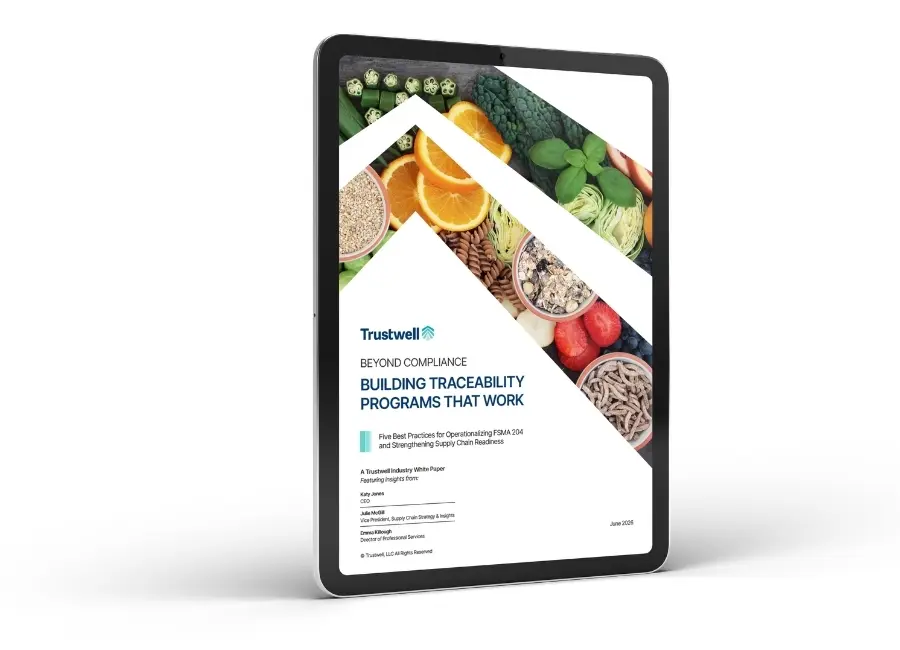
Successful traceability programs require coordination across people, processes, data, trading partners, and technology systems. This whitepaper gives food safety, quality, supply chain, procurement, operations, IT, and regulatory teams a practical framework for moving traceability from planning into execution.

Find Your Traceability Starting Point
Use the supplier maturity model and 10-question self-assessment to evaluate readiness, identify gaps, and prioritize next steps across suppliers, data, governance, recall procedures, and continuous improvement.

Real-world Insight from Traceability Experts
Get practical guidance from Trustwell experts Katy Jones, Julie McGill, and Emma Killough, shaped by years of experience across supply chain strategy, professional services, traceability implementation, food safety, supplier management, recall readiness, and operational change.

A Practical View of FSMA 204 Readiness
Learn how to evaluate traceability, recordkeeping, and data capabilities, then connect those findings to critical tracking events, key data elements, supplier onboarding, technology enablement, and continuous improvement.
Guidance for Cross-Functional Adoption
Explore why traceability programs need executive ownership, role-based training, defined responsibilities, supplier engagement, and clear adoption metrics to support long-term success.

Supplier Readiness Strategies
See how early supplier engagement can improve participation and data quality through shared expectations, onboarding resources, documentation standards, pilot programs, and ongoing performance monitoring.

Data and Interoperability Priorities
Understand how standardized identifiers, complete records, governance, and system connectivity can support cleaner data exchange and stronger traceability performance.
Start Moving Traceability Forward Now:
Lay the Foundation
Start with education and readiness planning. Trustwell resources can help your team understand FSMA 204 concepts, traceability terminology, and the operational steps needed to prepare.
Start Strong
Work with Trustwell traceability experts to assess your current processes, identify product and supplier readiness gaps, and build a practical path toward stronger traceability operations.
Build for Scale
FoodLogiQ Traceability supports farm-to-fork tracking, supplier data exchange, product visibility, and faster access to information during recalls, investigations, and audits.

Build Traceability With Confidence